


PAOLO ANGELI & TENORE MURALES DE ORGOSOLO
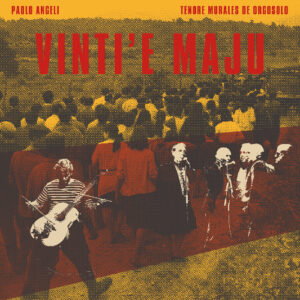
VINTI ‘E MAJU
VINTI ‘E MAJU
 PRIVATE PRESS PAGE RESERVED FOR PROMOTIONAL USE ONLY
PRIVATE PRESS PAGE RESERVED FOR PROMOTIONAL USE ONLY
PAOLO ANGELI & TENORE MURALES DE ORGOSOLO
VINTI ‘E MAJU
Release date: May 20, 2026
Label: ANMA Productions /ReR Megacorp
Scheduled for release on May 20th, VINTI ‘E MAJU is an album created by two outstanding representatives of Sardinian music: the traditional one, expressed by Tenore Murales de Orgosolo, and the contemporary one, rooted in Paolo Angeli’s Gallurese singing.
The protagonists of this record embrace the complexity, diversity, and innovative strength of a musical tradition that seeks dialogue with other languages, in this case, with innovative music.
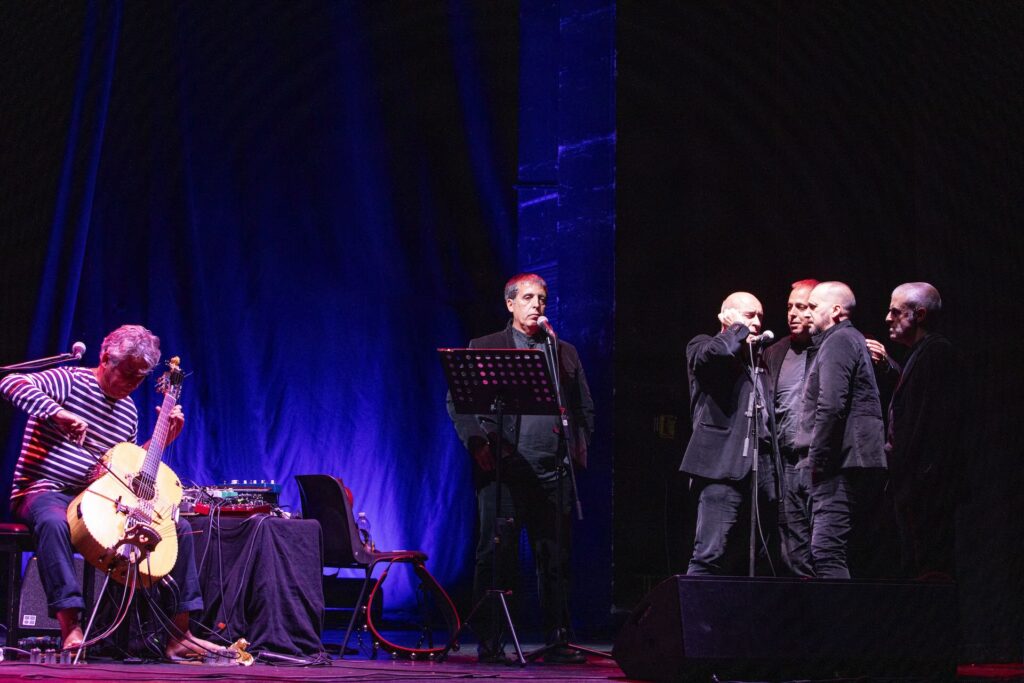
On one side, we find the prepared Sardinian guitar, an “alien” instrument that has fascinated music critics across Europe and overseas; on the other, the guttural singing of Tenore Murales, an expression of one of the oldest polyphonic traditions in the Mediterranean, with similarities found in Tuva and Mongolia.
In VINTI ‘E MAJU, the musical encounter takes place on different levels. The collaboration between Tenore Murales de Orgosolo and Paolo Angeli begins with the assimilation of the Tenore’s traditional language grammar and extends to guitar practices and repertoires from Gallura and Logudoro. The perspective is that of an island in the heart of the Mediterranean, but even more so of an island within the island: Orgosolo, which generates a textual and dialectical dialogue with other musical cultures, without ever renouncing its specificity.
The title VINTI ‘E MAJU refers to the return of shepherds to communal lands in spring. In Orgosolo, in May 1969, this return intersected with the long wave of the 1968 protest movements.
The result is a joyful, meditative, and explosive journey in its solemnity and unpredictability, carried by a flow in which traditional styles emerge: Isterridas, Amutos, a sa Seria, Lestra, Vardeina, rhythms and twists ‘a Ballu Hantau, vertiginous dances marked by the sound of sa trunfa (jaw harp) and su sunetu a bucca (harmonica). The album drags us across uninhabited lands, where sound erupts in jagged, acidic pulsations, on the edge of punk, only to rest in cold experimental areas where voices abandon choral unity and exist in their individual evocative power.
VINTI ‘E MAJU can only be fully understood by analyzing the political strength of the message expressed in its lyrics: in the verses of Remundu Piras, Peppino Marotto, Peppe Sotgiu, Peppinu Mereu, Franco Fresi, Gigi Angeli, and Maurizio Bassu, a true backward journey through the history of Sardinia emerges—sometimes shaped, sometimes endured—from the previous century to today. Various themes are addressed: identity, self-determination, building and energy speculation, anti-colonialism, anti-militarism, emigration, religion, love, and education—reaffirming the importance that Tenore singing has had in Orgosolo as a vehicle for social and political protest, struggle, and demands for change.
The dialogue between Paolo Angeli and Tenore Murales unfolds through both improvisation and the writing of imaginary scores, enriched by delicate field and historical recordings (from the Santa Cecilia archive) of Orgosolo’s prioresses reciting the Rosary. Among the soundscapes evoking a journey into the heart of Sardinia, moments of memory and beauty emerge, such as Sa Lota ‘e Pratobello (Peppino Marotto), a composition that retraces the peaceful struggle of the Orgosolo community in June 1969 against the establishment of a military firing range.
It is rare for such an intense dialectical encounter to occur between avant-garde expressions, urban countercultures, and the musical tradition of Barbagia. Several musicians from the international experimental scene have been fascinated by this folk art—from Frank Zappa to Ornette Coleman, from Tom Zé to cellist Ernst Reijseger. Consider visionary episodes, such as the album recorded in 1977 by Marcello Melis with Tenore Rubano di Orgosolo, among the main vocal groups to seek encounters with other musical forms.
In the album VINTI ‘E MAJU, wherever words are not enough, we experience an unprecedented journey suspended between Sardinia, post-rock, and avant-garde jazz, showing once again the vitality and the desire for dialogue between the leading exponents of the Orgosolo tradition and one of the beacons of international experimental music.
A documentary about the album, directed by Alberto Diana, will tell the story of the extraordinary meeting between Paolo Angeli and Tenore Murales.
Paolo Angeli
prepared Sardinian guitar, voice, electronics.
Paolo Angeli grew up facing the sea in Palau at the northern tip of Sardinia. Starting from a traditional instrument, he designed a true “orchestra guitar”: 25 strings, a hybrid between baritone guitar, cello, and percussion, equipped with hammers, pedalboards, and variable-pitch propellers. With this unique creation, the Sardinian musician reworks, improvises, and composes an unclassifiable music suspended between free jazz, folk noise, minimal pop, and post-rock.
Since the mid-1990s, Paolo Angeli has released 10 solo albums. He has been living in Barcelona since 2005, and regularly tours major festivals and theaters worldwide. In 2018, he performed at Carnegie Hall in New York, joining the ranks of the most important “innovators with roots” on the global scene. Among the different notable encounters in his musical life, first and foremost meeting Giovanni Scanu – true guardian of Gallurese and Logudorese guitar traditions – and avant-garde master Fred Frith were decisive, as well as meeting American guitarist Pat Metheny in 2003, who requested a new, custom model of Paolo’s prepared Sardinian guitar. He has improvised and collaborated with Fred Frith, Iva Bittová, Hamid Drake, Evan Parker, Antonello Salis, Pat Metheny, and Jon Rose, among others.
Tenore Murales de Orgosolo
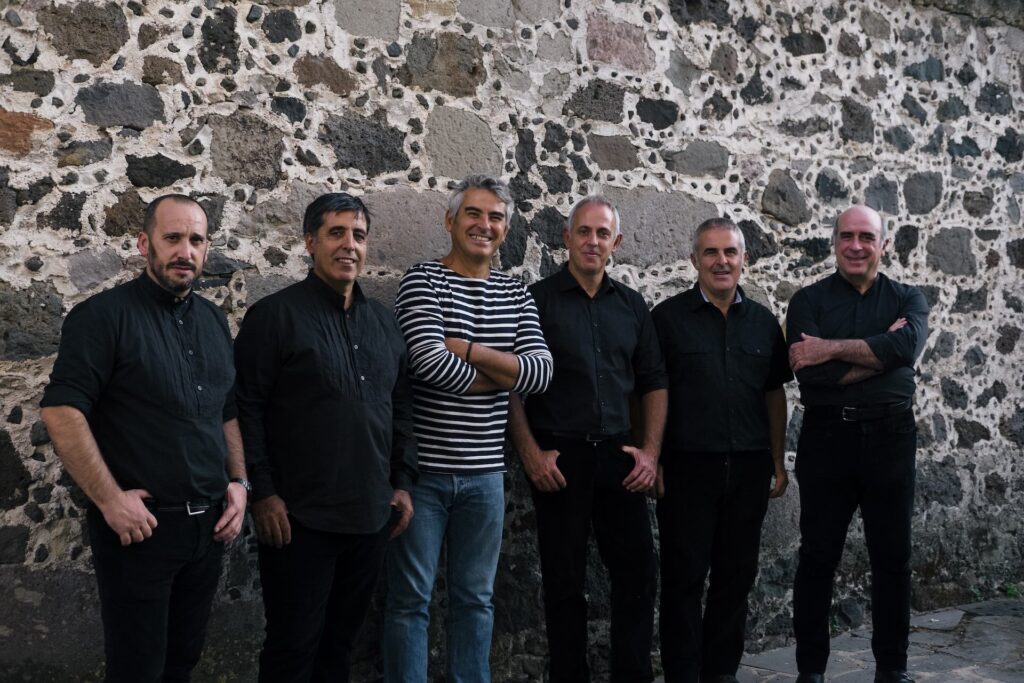
Franco Corrias voche
Salvatore Musina, Cosimo Mureddu sas mesuvohes
Maurizio Bassu sa hontra
Antonio Musina bassu
Tenore Murales of Orgosolo is one of the most important ensembles in Sardinia’s vocal heritage.
Founded in 1991, it soon became a Cultural Association, also including a dance group and various instrumentalists, with the goal of preserving, enhancing, and promoting local language, culture, and traditions. In nearly thirty years of activity, its artistic work and intense cultural activity has been particularly notable, which has led the group to participate in hundreds of events in Sardinia, mainland Italy, and abroad. Tenore Murales has promoted cultural events and music festivals, conducted studies on Orgosolo’s folk traditions, edited several books, and since 1995 organized singing and dance courses in schools.
The group has taken part in numerous national and international festivals. On September 22, 2013, Tenore Murales and its dance group performed in the presence of Pope Francis during his pastoral visit to Cagliari to seal the bond between the Sardinian capital and Buenos Aires in the name of Our Lady of Bonaria.
Tenore Murales has produced several recordings. Among them, the 2018 album No sias isciau (“Do not be a slave”), winner of the Mario Cervo Record Award 2019, stands out. It is accompanied by a book offering an analysis of Orgosolo singing, retracing its history and serving as a listening guide. For the first time, all ten performance modes of the Orgosolo Tenore are included on a single CD, and, for the first time, two Tenores appear on the same record, sometimes singing separately and sometimes together, in a style known in Orgosolo as Mibelli. The book, written by Banne Sio in Sardinian, Italian, and English, provides an in-depth analysis of Orgosolo singing, from its distinctive features to an analysis of all of the performance modes in the repertoire.